.png?width=20&name=canada%20(1).png)


Most guides on this topic start with "here's how to surcharge" and end with a sign-up form. This one starts somewhere different: should you surcharge at all?
For a lot of Canadian businesses, the honest answer is no. And a guide willing to say that is more useful than one that isn't.
If you've been searching for clear answers on credit card surcharge rules in Canada or whether you can charge customers credit card fees, you're in the right place. Here's the full picture.
What Surcharging Actually Means In Canada
Credit card surcharging became legal for most Canadian merchants in October 2022, following a class-action settlement involving Visa and Mastercard.
The rules:
- Quebec is excluded. Provincial consumer protection law prohibits surcharging there. If you have locations or customers in Quebec, those transactions are off limits.
- The cap is 2.4%. You cannot charge customers more than what you actually pay to the card network, and never more than 2.4%, whichever is lower.
- You need 30 days' notice. Before you start, you must notify Visa and Mastercard in writing.
- Disclosure is mandatory. The surcharge must appear as a separate line item on the receipt, communicated before payment.
- Credit cards only. Debit transactions are not eligible.
That's the general setup for surcharging in Canada in 2026. Now the harder question, whether or not surcharging is right for you. If you want a deeper look at what you're actually paying in processing fees before you decide, our fee guide is a good place to start.
The Case For Surcharging
As an example of how the math works out: on $50,000 in monthly credit card volume, recovering 1.5% in fees puts $750 back in your pocket each month, or $9,000 over a year.
Surcharging is a straightforward call for certain businesses:
Auto repair, B2B invoicing, medical and dental offices, contractors all deal with high ticket and low frequency transactions. A customer who comes in once for a $3,000 job doesn't carry the same loyalty calculus as a café regular. The surcharge here is essentially a rounding error on the total bill.
Thin-margin industries feel this differently. If you're running at 5–8% net margin, paying 1.8–2.4% in processing fees is a significant slice. Getting some of it back changes the unit economics.
Some operators skip the surcharge language entirely and post a higher base price with a discount for cash or debit. A $100 list price with a 2% surcharge brings the card total to $102, while a $102 list price with a $2 cash discount lands the cash customer at $100. The revenue outcome is roughly the same; the psychology at checkout isn't. Customers respond better to saving money than to paying extra, even when the dollar amounts are identical. If your customer base skews price-sensitive or your brand leans toward hospitality over utility, the discount framing is worth considering.
The argument for surcharging is simple: you're already absorbing a cost your customers are generating. Making it visible and optional is a reasonable business decision.
The Case Against Surcharging (And It's Stronger Than Most Guides Admit)
Most Canadian consumers have never hit a credit card surcharge at checkout. When they do, the reaction is rarely neutral.
In a market where your competitor down the street doesn't surcharge, you've handed them a talking point. You may recover $0.60 on a $40 transaction and lose the next five visits. According to a 2025 Canada Credit Card Satisfaction Study, in 88% of instances where a merchant applies a surcharge, customers switch to an alternate payment method, and satisfaction scores among cardholders who've been surcharged are 42 points lower than those who haven't. Loyalty-driven businesses like cafes, salons, restaurants, and boutiques are the most exposed to that dynamic.
There's also a detail that catches business owners off guard: your surcharge can't exceed what you actually pay, and many processors charge above 2.4%. If your effective processing rate is 2.8%, your surcharge is still capped at 2.4%. You're still eating the gap. And if you're on a flat-rate or tiered plan, your rate on premium rewards cards may be higher than you realize. Surcharging doesn't fix a bad processing rate, it only patches over it.
Then there's the operational side. Implementing this correctly means updating your POS, training staff on disclosure rules, adding signage, and fielding complaints. Not prohibitive, but for a busy counter environment, the friction is ongoing.
There's a subtler cost too: staff discomfort. Most front-line employees don't love explaining a surcharge to a customer who wasn't expecting it. That conversation, repeated dozens of times a day, creates low-grade friction inside your business as well as at the checkout. It's not a dealbreaker, but it's a real operational cost that rarely shows up in the calculation.
Finally, if your business has any digital or physical reach into Quebec, you need a reliable way to exclude those transactions. For purely local businesses with no Quebec exposure, this isn’t an issue. For anyone with e-commerce or multi-province customers however, it's a real compliance risk.
Where Surcharging Makes Most Sense
The businesses that fit this best share two traits: high average tickets and low visit frequency.
The reason these work comes down to frequency and psychology. When someone is paying $1,800 for a transmission repair or $4,000 for a roof inspection, a 2% surcharge is $36 or $80. It's visible on the receipt, but it doesn't change the decision. The customer came to you because of your reputation, your availability, or a referral, not because you were the cheapest option in a crowded market. And because they're not back next week, the surcharge never gets the chance to accumulate into resentment. The same logic extends to B2B: clients running expense processes are unlikely to push back the way a retail consumer would, and some won't notice at all.
If you'd rather avoid the word "surcharge" on a receipt entirely, the cash discount model covered earlier is often the cleaner path for these same business types.
Where It Probably Doesn't
Cafes, bakeries, quick-service restaurants, salons, spas, boutique retail with a regular base, any business near Quebec, or any business in a competitive local market where customers can easily go somewhere else.
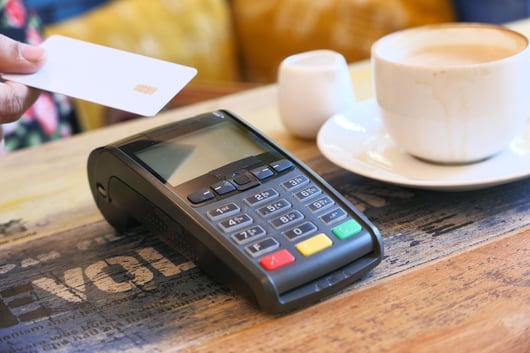
Cafes are the clearest example. A $0.70 surcharge on a $6 latte isn't going to make anyone visibly angry, but it introduces friction that didn't exist before, and in a neighbourhood with three other cafes on the same block, friction is a reason to try somewhere new. Once a regular starts trying somewhere new, they may just stay there.
Salons and personal service businesses have an additional wrinkle: the client relationship is personal. People are loyal to their stylist, their aesthetician, their massage therapist. But that loyalty has a ceiling, and small fees have a way of nudging people to finally book that trial appointment elsewhere they've been putting off.
Quick service restaurants (QSRs) deserve a specific mention. The average ticket is low, the volume is high, and lunch regulars are exactly the kind of customer who notices a new fee and starts doing the mental math on whether the place down the street is just as good. A surcharge at a QSR is a recurring reminder that the experience costs more than it used to, and that's hard to undo once the perception sets in.
The Smarter Alternative For Most Businesses
Processing fees are eating your margin and that's why surcharging looks attractive. But it's one response to that problem, not the only one.
The alternative is paying less in processing fees to begin with.
Most small and mid-sized Canadian businesses are on flat-rate or tiered pricing plans, and while they’re simple to understand, they can be expensive in practice.
Interchange-plus pricing works differently. It passes through the actual card network cost and adds a small transparent markup on top, so you see both numbers on your statement. For businesses doing real card volume, the savings are often comparable to what surcharging would recover, without the customer friction, the compliance overhead, or the staff training.
Paystone's interchange-plus pricing works this way. You see exactly what you're paying and why. If you want to know whether your current rate is competitive, our team will run a free comparison against your existing statements.
If surcharging makes sense for your business, we'll tell you that. If it doesn't, we'll show you where the savings actually are.
How To Set It Up If You Do Decide To Surcharge
-
1. Notify Visa and Mastercard at least 30 days out. Both have online forms for merchants.
-
2. Notify your processor. They need to configure the surcharge in your system.
-
3. Update your POS so the charge is applied and itemized automatically.
-
4. Add signage at the entrance and at checkout. Disclosure before payment is required.
-
5. Brief your staff. Something simple works: "We charge a 2% fee for credit card transactions. Debit and cash aren't affected."
-
6. Check your effective rate first. If you're paying above 2.4% to your processor, your surcharge has to be capped lower than that. Confirm the number before you go live.
If you decide surcharging is the right call, Paystone can configure it correctly and handle the processor side. Here's how it works.
The Bottom Line
Surcharging isn't a bad idea. It's just a specific idea that fits specific businesses. If your customers come in rarely, spend a lot, and choose you for reasons that have nothing to do with price, it's worth running the numbers. If your model runs on regulars and your market is competitive, the math rarely works in your favour once you factor in what you stand to lose.
For most businesses, the smarter move is getting your processing rate down to where it should be in the first place. The fee you're absorbing isn't fixed, it depends on how your processor is billing you, and a lot of business owners are paying more than they need to without realizing it. If interchange-plus is the right fit, Paystone's pricing works seamlessly, and if you've run the numbers and surcharging makes sense for your business, we can set that up too.
Either way, the decision starts with knowing your actual numbers and we can help with that.
Still not sure?
We'll show you exactly what surcharging would recover for your business, and what you'd save by switching to transparent pricing instead.
.png)